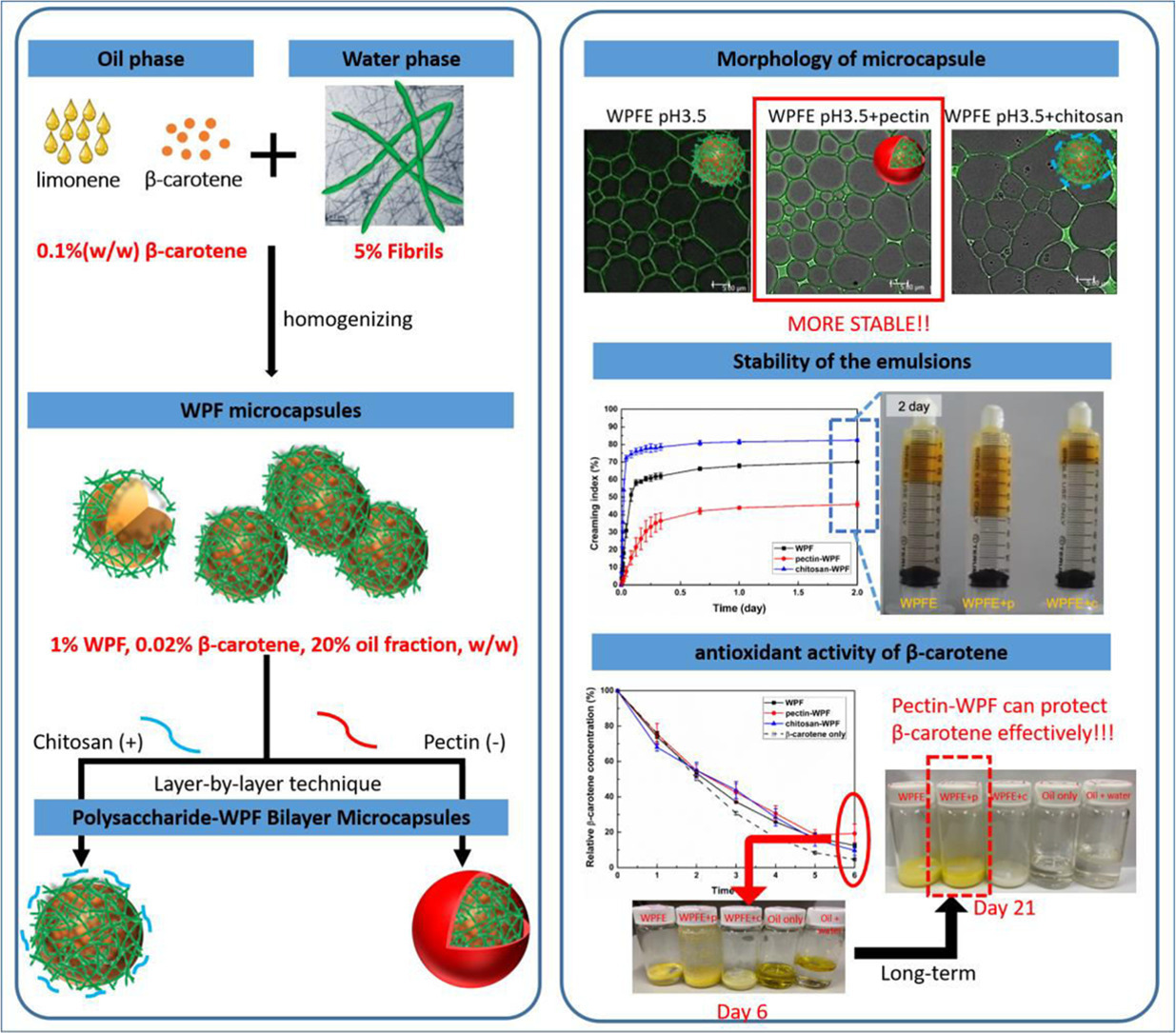
This study investigated the use of whey protein isolate fibrils (WPFs) combined with polysaccharides to form bilayer microcapsules for protecting β-carotene, a lipophilic antioxidant that is unstable in acidic environments. WPFs were first prepared and used to encapsulate β-carotene in a limonene-based emulsion, after which pectin or chitosan was added to form polysaccharide–WPF bilayer structures. The microcapsules were characterized for particle size, stability, morphology, and β-carotene retention under acidic conditions. The results showed that pectin–WPF microcapsules were more stable than WPF-only or chitosan–WPF systems and were particularly effective at protecting β-carotene and preserving its antioxidant activity in acidic environments. Overall, the study suggests that pectin–WPF bilayer microcapsules are promising biodegradable carriers for improving the stability and bioavailability of lipophilic bioactive compounds.
Reference & Publication
Yang, Y. Y., Lai, Y. R., How, S. C., Lin, T. H., and Wang, S. S. S. (2024).
“Encapsulation with a complex of acidic/alkaline polysaccharide-whey protein isolate fibril bilayer microcapsules enhances the stability of β-carotene under acidic environments.”
Journal of the Taiwan Institute of Chemical Engineers, 156, 105344.
DOI: 10.1016/j.jtice.2024.105344