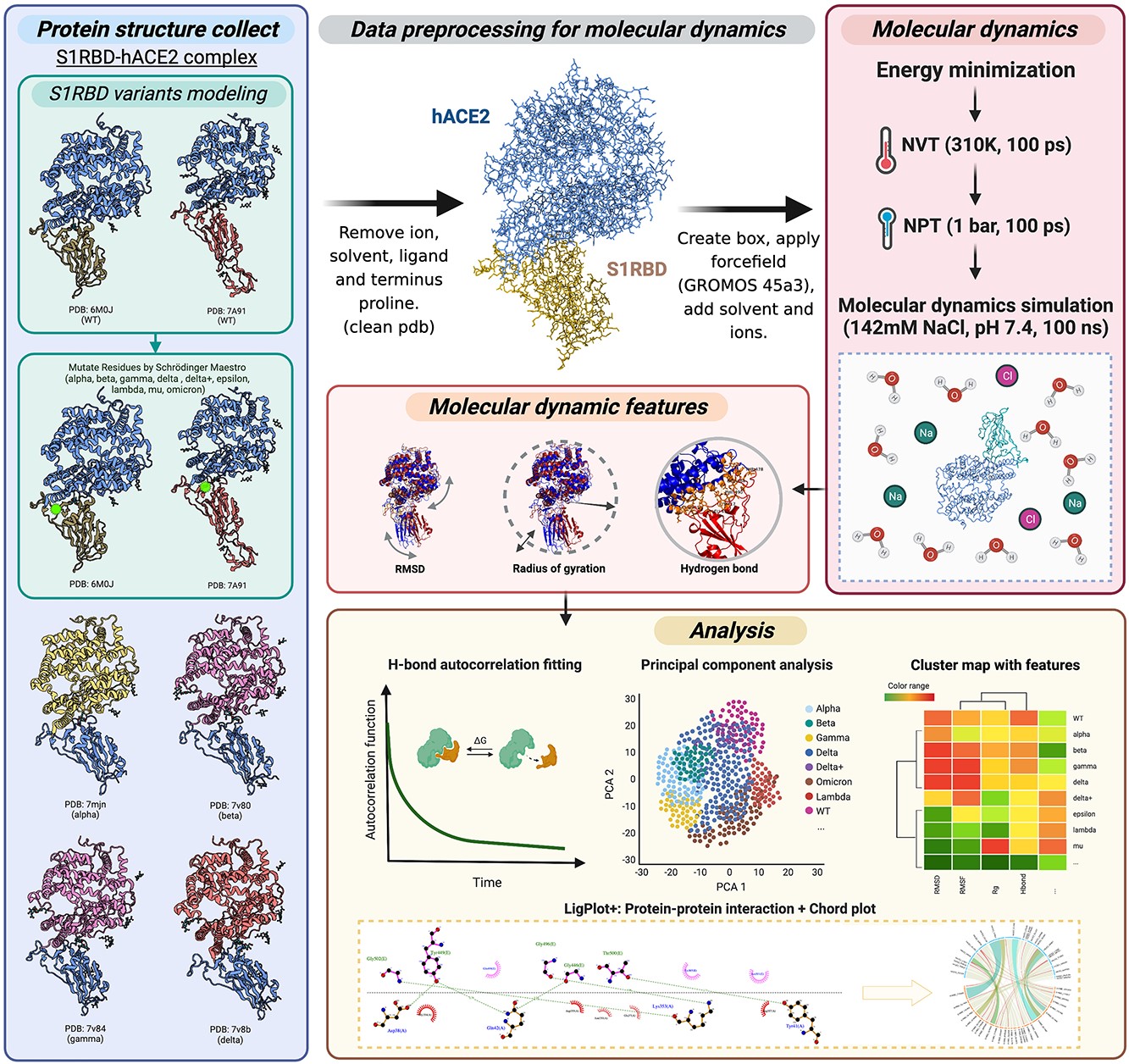
Why did omicron spread so much faster than earlier SARS-CoV-2 variants? We looked at this at the molecular level: where the spike protein’s receptor-binding domain meets the human ACE2 receptor.
We built models of 14 variants (alpha to omicron BA.5) from PDB structures and ran 100 ns MD simulations of each complex. The omicron complexes were more compact and formed more hydrogen bonds across the interface. Those bonds also broke and re-formed faster. PHE486 and TYR501 stood out as key residues. These features fit with omicron’s higher transmissibility.
Know more from reference…
- Yang, Y. Y. and Tseng, Y. J. (May 2023). “The evolution of SARS-CoV-2 Omicron Variants on the spike-protein and hACE2 interface – determined by the hydrogen bonding formations.” Briefings in Functional Genomics, DOI: 10.1093/bfgp/elac053
- Yang, Y. Y. and Tseng, Y. J. “Competitive analysis of different SARS-CoV-2 variants in United Kingdom, Israel, South Africa, Brazil and Peru.” American Chemical Society (ACS) Spring 2022. (virtual, 20–24 Mar.)